Auto Accident Chiropractor Buffalo
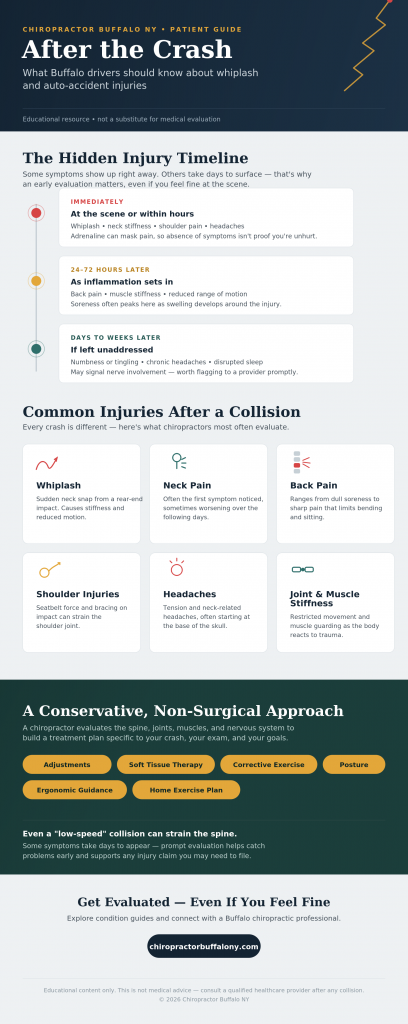 Learn About Common Car Accident Injuries, Delayed Symptoms, and Conservative Treatment Options
Being involved in a motor vehicle accident can be a frightening and stressful experience. Even collisions that appear relatively minor can place significant forces on the body, affecting the muscles, ligaments, joints, discs, and nerves of the neck and back. While some injuries cause immediate pain, others may not become noticeable until hours or even days after the accident.
If you’re searching for an Auto Accident Chiropractor in Buffalo, you may have questions about what symptoms to watch for, when to seek medical care, and whether chiropractic treatment may be appropriate as part of your recovery. This guide is designed to provide educational information about common accident-related injuries, how they’re evaluated, and the conservative treatment options that may be available.
Whether your accident occurred on the New York State Thruway, Interstate 190, Route 33, or on a neighborhood street in Buffalo, understanding your injuries is an important first step toward making informed healthcare decisions.Why Even Minor Accidents Can Cause Injuries
One of the biggest misconceptions about automobile accidents is that a vehicle must sustain significant damage for the occupants to be injured.
In reality, the human body absorbs tremendous forces during a collision. Even at relatively low speeds, your body may be pushed forward, backward, or sideways in a matter of milliseconds.
During this rapid movement:
- Muscles may stretch beyond their normal limits.
- Ligaments that stabilize the spine can be strained.
- Spinal joints may become irritated.
- Intervertebral discs may experience increased pressure.
- Nerves may become compressed or inflamed.
- Soft tissues throughout the neck and back may be injured.
Modern vehicles are designed to absorb impact and protect occupants from life-threatening injuries. However, while seat belts and airbags save lives, they cannot completely eliminate the forces acting on your spine during a crash.
Why Symptoms Are Often Delayed
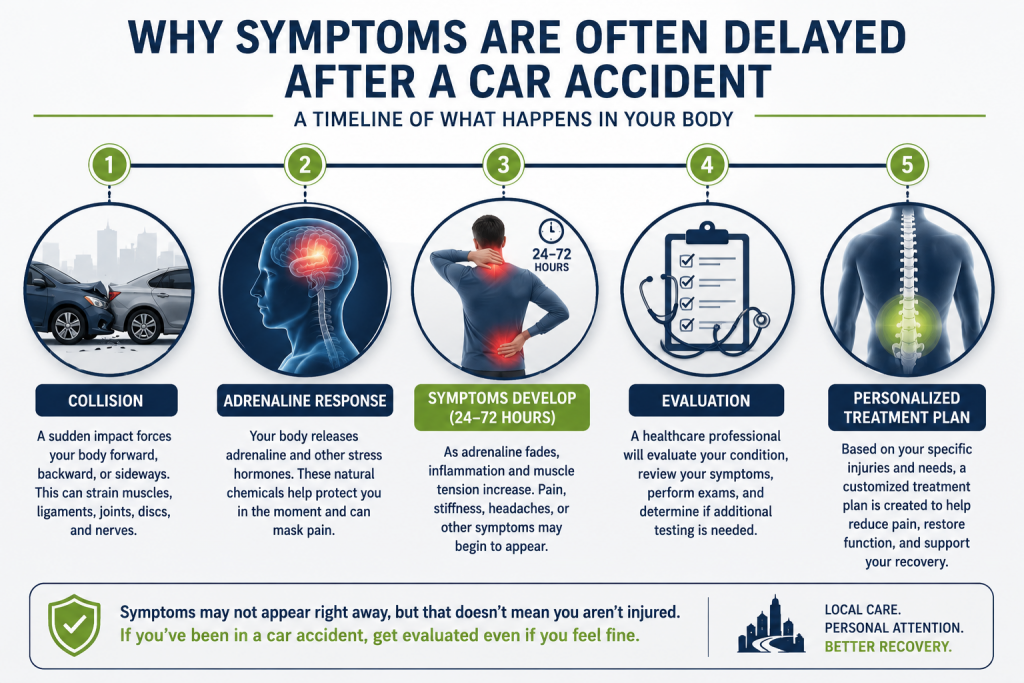
Many people walk away from an accident believing they were not injured because they don’t feel pain immediately.
This is surprisingly common.
Following a traumatic event, the body releases adrenaline and other stress hormones that can temporarily mask pain. As these hormones decrease over the next several hours or days, inflammation and muscle stiffness may begin to develop.
It’s not unusual for accident victims to notice symptoms such as:
- Neck stiffness the next morning
- Increasing back pain over several days
- Headaches developing later that evening
- Shoulder discomfort after returning to work
- Tingling or numbness appearing hours later
- Reduced range of motion as inflammation increases
Because symptoms may be delayed, many healthcare professionals recommend paying close attention to your body following an accident and seeking an evaluation if pain or stiffness develops.
Common Injuries Following an Auto Accident
Every collision is different, and injuries vary depending on factors such as speed, direction of impact, seat belt use, and the position of the occupants.
Some of the most common injuries include:
Whiplash
Whiplash occurs when the head and neck are rapidly forced backward and forward during a collision. This sudden movement can strain muscles, ligaments, tendons, and joints in the cervical spine.
Common symptoms include:
- Neck pain
- Neck stiffness
- Headaches
- Shoulder pain
- Limited range of motion
- Muscle spasms
Whiplash is one of the most frequently reported injuries following rear-end collisions.
Back Injuries
The lower and middle back are also commonly affected during motor vehicle accidents.
Injuries may involve:
- Muscle strains
- Ligament sprains
- Joint irritation
- Disc injuries
- Soft tissue damage
Symptoms may include localized pain, stiffness, muscle spasms, or pain that increases with movement.
Herniated or Bulging Discs
The force generated during an accident may contribute to damage involving the spinal discs.
When a disc bulges or herniates, nearby nerves may become irritated, potentially leading to symptoms such as:
- Pain radiating into the arms or legs
- Tingling
- Numbness
- Muscle weakness
- Difficulty sitting or standing comfortably
Because several different conditions can produce similar symptoms, an accurate diagnosis is important before beginning treatment.
Sciatica
Some people develop sciatic nerve irritation following an automobile accident.
If structures within the lower spine place pressure on the nerves that form the sciatic nerve, symptoms may include:
- Lower back pain
- Buttock pain
- Pain traveling down one leg
- Tingling
- Numbness
- Weakness
If you’d like to learn more about this condition, be sure to visit our Sciatica Chiropractor Buffalo guide.
Shoulder Injuries
During an accident, drivers often brace themselves by gripping the steering wheel tightly or extending their arms.
This can contribute to:
- Shoulder strains
- Rotator cuff injuries
- Reduced range of motion
- Pain while lifting the arm
Shoulder pain may not become noticeable until inflammation develops later.
Headaches
Headaches are another common complaint following motor vehicle accidents.
They may result from:
- Muscle tension
- Neck injuries
- Whiplash
- Joint irritation
- Other accident-related injuries
Persistent or severe headaches following an accident should always be evaluated by an appropriate healthcare professional.
Every Injury Is Different
No two automobile accidents are exactly alike.
Factors that influence injuries include:
- Vehicle speed
- Direction of impact
- Airbag deployment
- Seat belt use
- Vehicle size
- Occupant position
- Previous injuries
- Overall health
Because every accident is unique, treatment recommendations should always be based on a thorough examination and an accurate diagnosis rather than assumptions about the type of collision. Also NY has No Fault Chiropractic care after an auto accident. Call to find out more.
Why Early Evaluation Matters
Even if your symptoms seem minor, obtaining an appropriate medical evaluation after an automobile accident can be important.
A healthcare provider can assess your symptoms, perform a physical examination, determine whether additional testing is needed, and recommend an appropriate treatment plan based on your individual condition.
Early evaluation may also help identify injuries that are not immediately obvious and provide guidance on activity modifications, rehabilitation, and follow-up care when necessary.